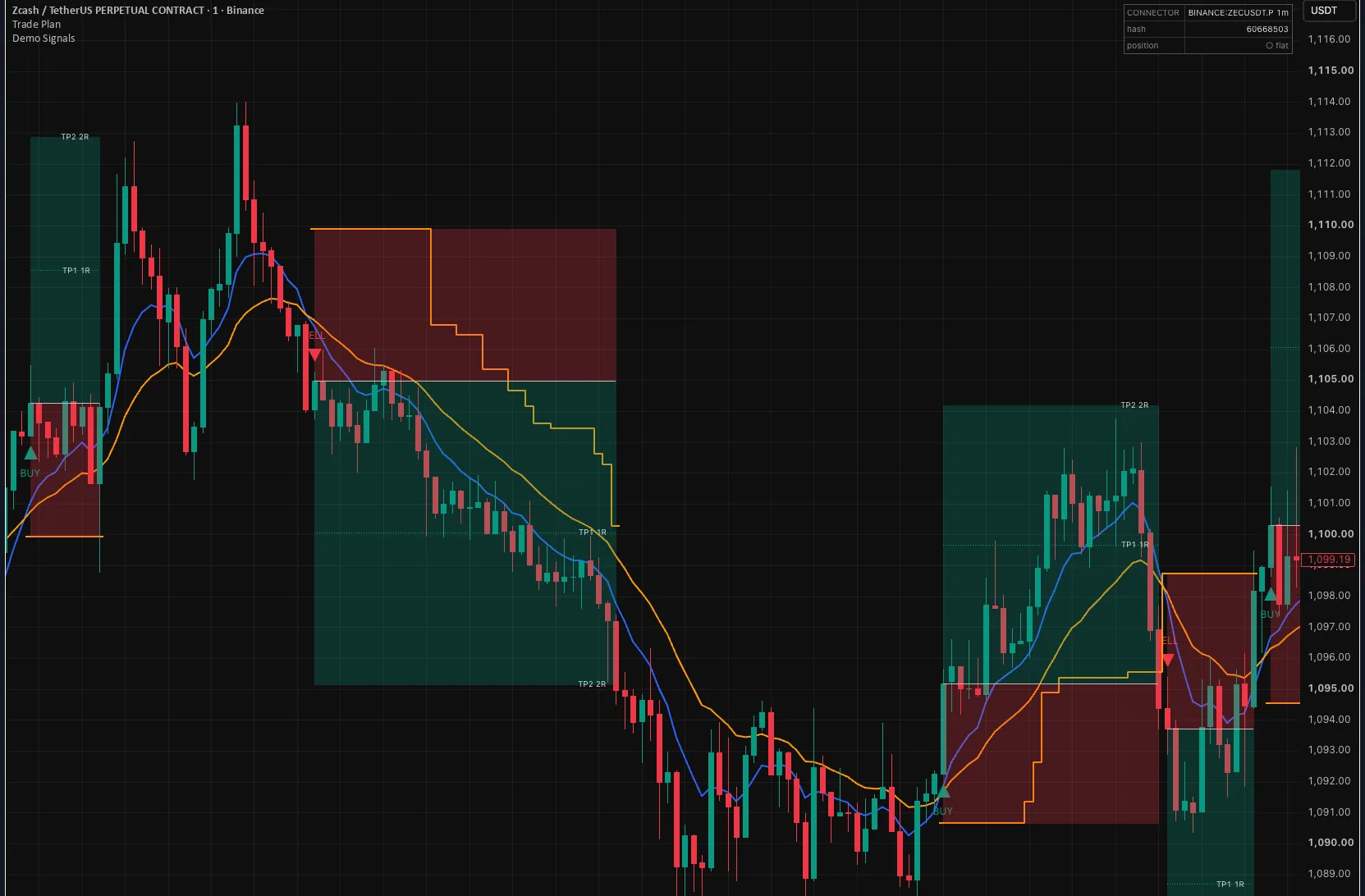
Zones, ladders and a stepped stop.
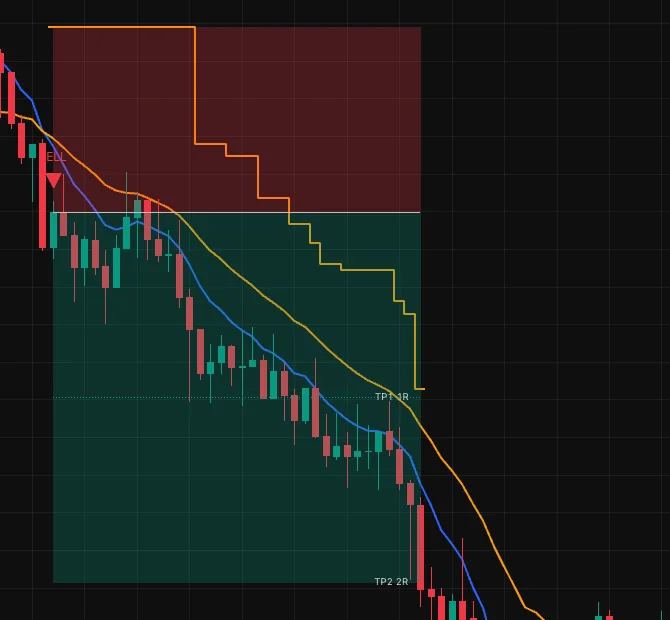
Each entry draws its risk and reward zones, a label per take-profit level, and a stop line that steps as break-even and trailing moves happen. What you see on the chart is what the alerts describe.
The Signal Connector reads the buy and sell plots of the indicator you already use, draws the stop, targets, break-even and trailing stop on your chart, and sends one structured alert for every step. Point that alert at HookTrader and the plan executes on Binance Futures.
Free · Protected source · Adds no signals of its own
Published on TradingView as “Trade Plan Visualizer — SL/TP & Alerts”

Free, for any indicator
Wire in the buy and sell plots of whatever you already trade with. It adds no signals of its own.
A plan you can see
Stop, targets, break-even and trailing drawn on the chart before a single alert fires.
Nothing to copy-paste
The indicator writes the alert JSON itself. One alert covers the whole trade.
Backtest in R
Replay the plan over the chart's history: win rate, profit factor, drawdown, streaks.
Most signal indicators stop at an arrow on a bar. The connector picks up from there: where the stop goes, where the targets sit, when the stop moves, and what to tell the receiver at each step.

Each entry draws its risk and reward zones, a label per take-profit level, and a stop line that steps as break-even and trailing moves happen. What you see on the chart is what the alerts describe.
Zero-Line Pulse for one-bar markers, Value Change for step plots, Threshold for RSI over 50 or an EMA cross — no extra script.

Move the stop to entry after a chosen target, then trail it by ATR, percent or an external plot. The stop only ever tightens.
Every take-profit is a multiple of the initial risk, so one plan works on any symbol at any position size.
entry, tp_hit, move_sl, trail and exit share one client_id, so a receiver can follow the whole trade.
A configuration hash on the chart and in every alert. HookTrader shows the same number, so drift is visible before it costs a trade.
Two on TradingView, one in HookTrader, and the fourth happens by itself.
Search TradingView's Indicators for Trade Plan Visualizer and add it next to your signal indicator.
Set Long and Short Signal Source to your indicator's buy and sell plots, pick the reading mode that matches them, and choose how the stop, targets and trailing are placed.
Condition: the indicator, "Any alert() function call". Paste the webhook URL from your HookTrader strategy. Leave the message box alone.
HookTrader sizes the position from your risk, places the stop and take-profits as native Binance orders, and follows every break-even and trail update the chart sends.
Full walkthrough with every setting in the Signal Connector guide.
Every message is one line of JSON with a shared envelope. HookTrader's Signal Connector preset reads it with no mapping rules to write, and the schema is documented, so any webhook receiver can consume it.
Every field, every event: events and payloads.
{
"v": 2,
"type": "entry",
"symbol": "BTCUSDT",
"ts": 1747140000000,
"exchange": "BINANCE",
"interval": "15",
"is_test": false,
"source": "signal-connector",
"connector_version": "1.2.0",
"price": 65000.0,
"side": "long",
"entry": 65000.0,
"sl": 64000.0,
"tps": [66000.0, 67500.0, 70000.0],
"config_hash": 1976682332,
"client_id": "BTCUSDT-1747140000-long"
}The indicator is complete on its own. HookTrader is the part that turns the plan into orders.
Free, on any TradingView chart.
The plan, executed on Binance USDⓈ-M Futures.
More questions answered in the full FAQ.
Add the indicator now — it's free — then create a free HookTrader account and watch it execute on paper. Live trading is by Solo invite.
Want live trading? Apply for a Solo invite.
Solo and Pro are by invite during early access · Free needs no card, no API key · Start free instead